A multidimensional representation of head-motion waveforms in sport — reading each recorded impact across structural, rotational–translational, spectral, and artefact domains, not collapsing it into a single number.
From principal component analysis on 4,402 head-motion events, 34 elite ice-hockey players — see Evidence.
From Holbourn's shear-strain hypothesis to Gennarelli's primate studies to HIC and BrIC — eighty years of evidence that impacts differ in kind, not just magnitude, and no standard that reads the waveform for what it is.
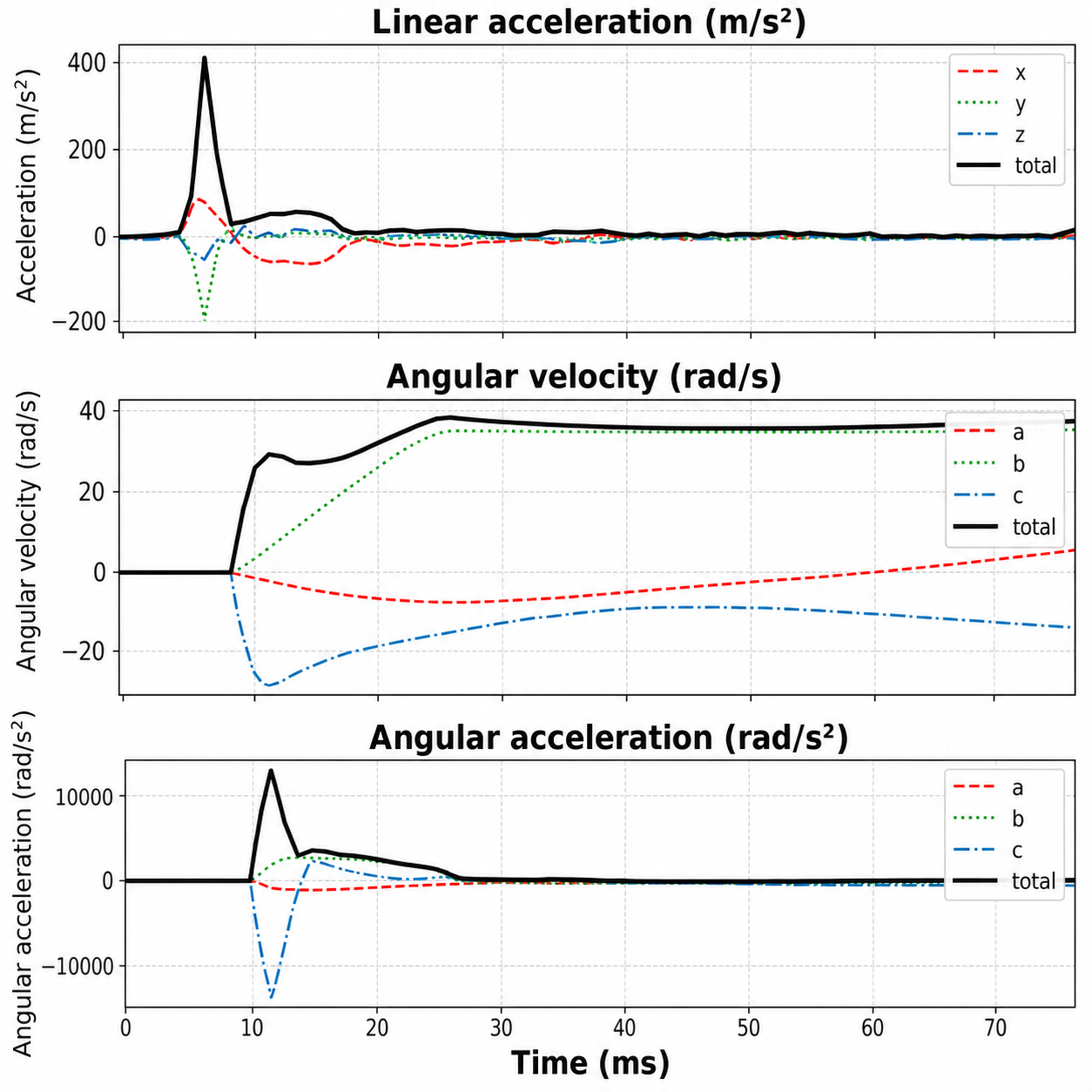
Standard wearable sensors report peak linear acceleration and peak rotational velocity: two scalar values summarizing an entire 75-millisecond event. That works as a rough ranking of intensity. It throws away everything about how the event unfolded — waveform shape, the timing between rotational and translational motion, and frequency content.
Two events with identical peak magnitude can differ sharply in duration, symmetry, and spectral character. Those differences are invisible to a peak-based description. They are exactly what the Impact Feature Space is built to represent.
Every recorded event becomes a point in a multidimensional space. The published manuscript organized this into four domains; the working pipeline has since grown to six. Either way, it's a structured description — not a single scalar summary.
Kurtosis, skewness, duration, onset and decay — is the event a sharp transient or a sustained, distributed load?
Short high-frequency impulses versus longer, lower-frequency contact — and how that content evolves over the event.
How much of the motion is rotational, how it's timed against linear motion, and how the two are coupled.
Which direction the motion concentrates in, and how stable that direction stays through the event.
Rotational energy split into axial, coronal, and sagittal components.
How patterned or irregular the waveform is, independent of its size or frequency.
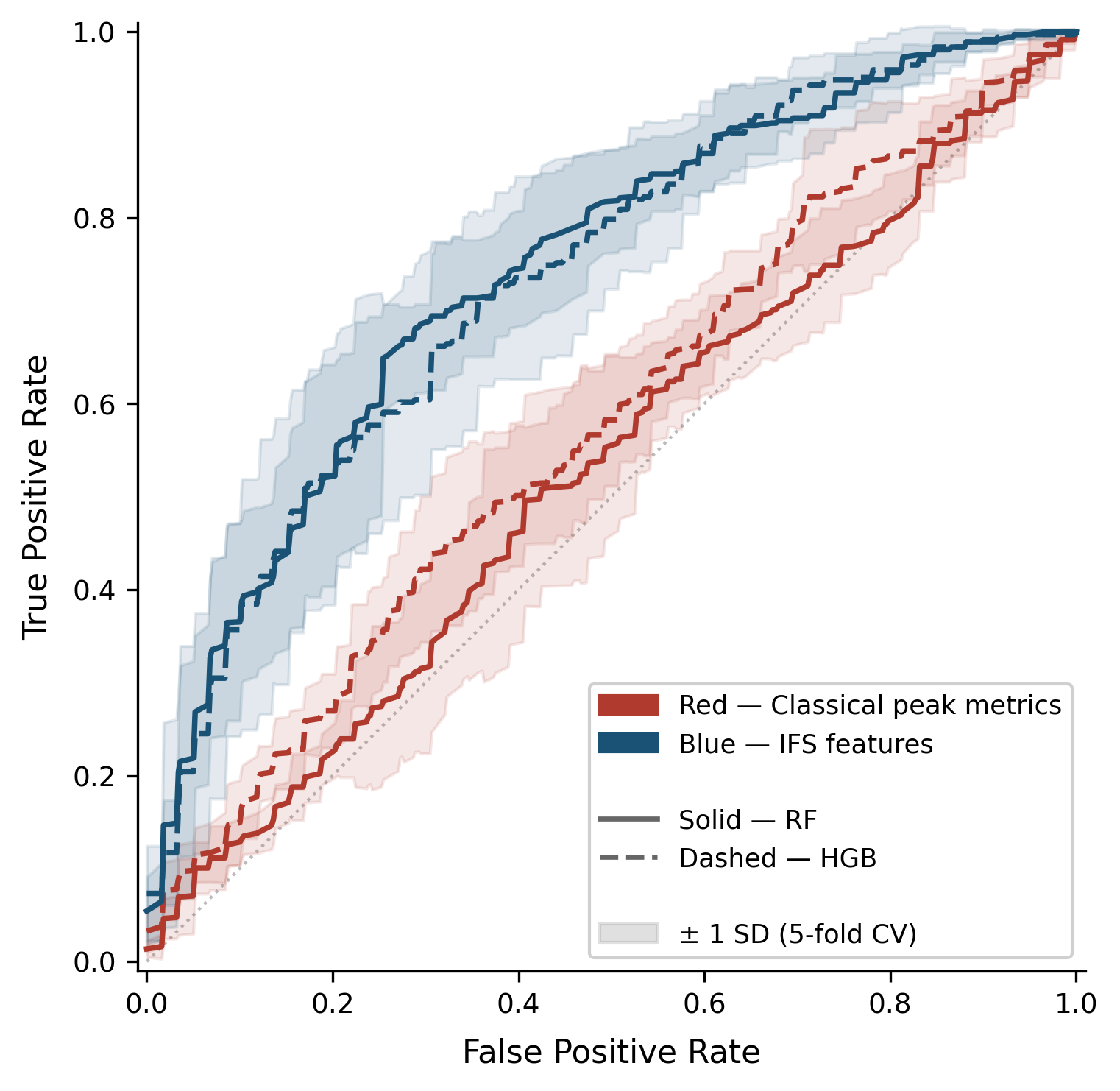
Using 661 events recorded during active gameplay — on-ice contact versus events recorded while seated on the bench, both crossing the same detection threshold, both within the same time window — peak kinematic features classified at chance (ROC-AUC 53–56%). IFS structural features, entered without any task-specific tuning, reached 73–74% AUC with two different classifier families.
Event context was independently confirmed against a separate player-tracking system, not derived from the sensor data itself.
The demonstration dataset is women's elite ice hockey. The six-domain structure of IFS is not sport-specific in principle — and that's a hypothesis worth naming plainly, not a finding.
Repetitive, purpose-directed low-magnitude loading.
HypothesisShort, rigid, high-frequency contact patterns.
HypothesisSustained, body-mass-mediated ice contact.
HypothesisPer-athlete baselines across a season of exposure.